The battery industry is entering a new phase of digital traceability in Europe. On 21 August 2026, the European Commission published updated guidance to help companies prepare for the Digital Batteries Passport under Regulation (EU) 2023/1542. The guidance brings together 71 data points and explains how they apply to different battery categories.
The key deadline is 18 February 2027. From that date, each electric vehicle (EV) battery, each light means of transport (LMT) battery, and each industrial battery with a capacity greater than 2 kWh that is placed on the EU market or put into service must have an electronic battery passport.
For energy storage companies, importers, distributors and project developers, this is not simply a new label requirement. It changes how battery information is collected, structured, updated and shared throughout the product lifecycle.
Two related requirements are easy to confuse:
For batteries covered by the passport requirement, the QR code provides access to the battery passport through a unique identifier. Other battery categories will also use QR codes, but the information linked through those QR codes is different. In other words: a QR code does not automatically mean a full battery passport.
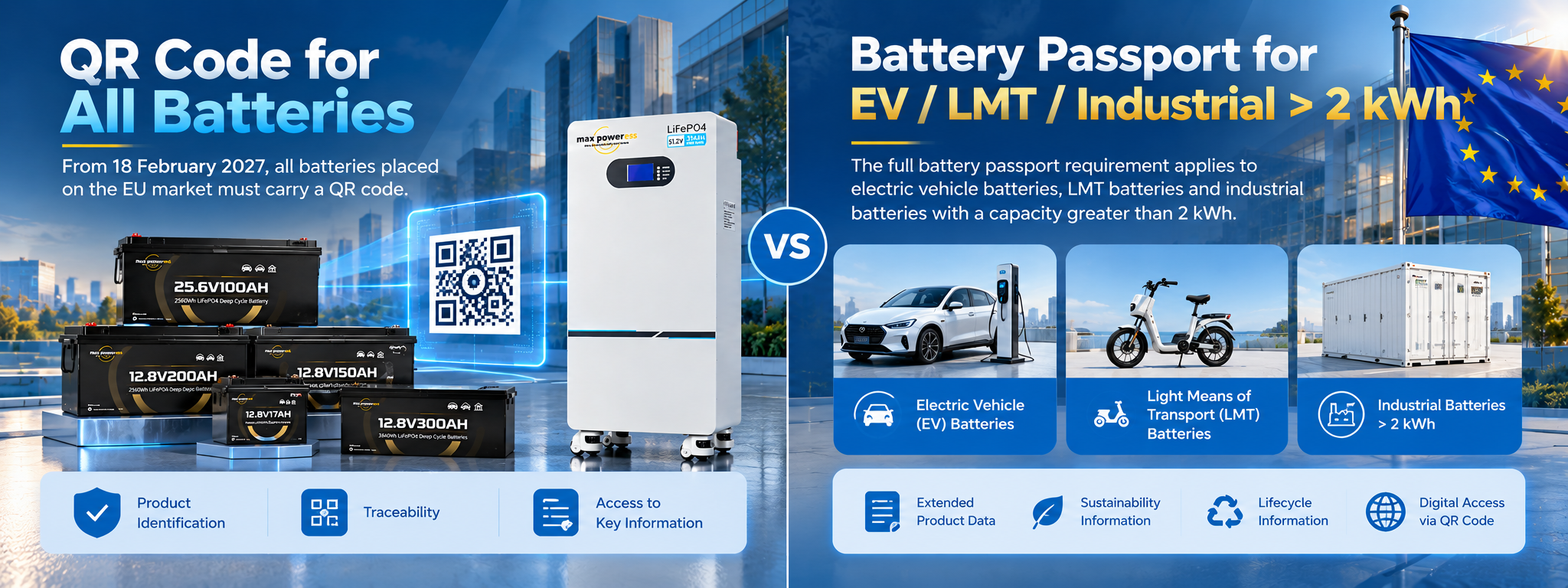
The battery passport requirement covers industrial batteries above 2 kWh, and the European Commission specifically identifies home storage batteries and industrial batteries among the affected product groups. This makes the regulation highly relevant to residential energy storage, commercial and industrial storage, and many larger lithium battery systems sold into the EU.
The important point is that compliance should be checked by battery category and product use — not simply by chemistry. A LiFePO4 battery, for example, is not included because it is LiFePO4; it is included when it falls within a regulated battery category and the applicable capacity threshold.
The passport is designed to provide structured information about both the battery model and the individual battery. Depending on the battery category and the applicable requirement, the information can include:
Not all passport information is visible to everyone. The Regulation provides different access levels. Some information is available to the general public; some is restricted to notified bodies, market surveillance authorities and the European Commission; and certain information is accessible only to parties with a legitimate interest, such as repairers, remanufacturers, second-life operators or recyclers.
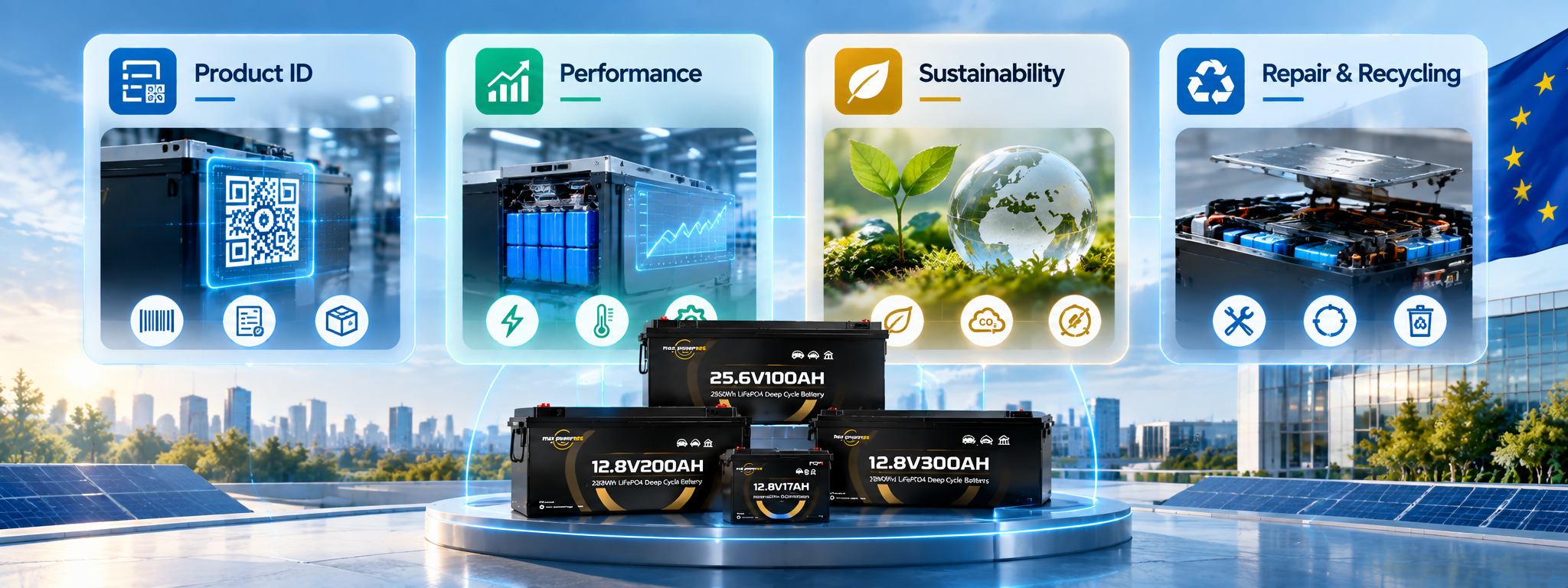
The European Commission’s updated 2026 guidance consolidates 71 data points across the battery categories covered by the passport. This does not mean that every battery must complete all 71 fields in exactly the same way.
The guidance identifies whether each data point is mandatory, optional, applicable only under specific circumstances, or not required to be completed or displayed as of February 2027 for a particular battery category. This distinction matters: companies should build their data process around the exact battery category and applicable requirements instead of treating “71 data points” as a universal checklist.
The Commission also notes that the guidance may be developed further as implementation progresses. Companies should therefore treat compliance preparation as an ongoing process rather than a one-time document exercise.
The responsibility lies with the economic operator placing the finished battery on the EU market. According to the Regulation, that operator must ensure that the information in the passport is accurate, complete and up to date. The operator may authorise another party in writing to act on its behalf.
For overseas battery manufacturers and European importers, this makes early responsibility-sharing especially important. A strong supply agreement should define who provides source data, who creates and maintains the digital passport, who manages the unique identifier and QR code, and who updates information when required.
The deadline may still be months away, but the difficult part is not printing a QR code. The real work is building reliable data behind it.
The battery passport should not be viewed only as a regulatory burden. For serious battery suppliers and buyers, stronger traceability can also improve quality control, after-sales service, warranty verification, recycling management and supply-chain transparency.
In the long term, buyers will increasingly expect a battery supplier to provide not only voltage, capacity and cycle-life specifications, but also structured product identity, material, performance and lifecycle information that can be verified digitally.
At Max Power, we are closely following the implementation of the EU Batteries Regulation and the Digital Battery Passport requirements. For energy storage projects, the direction is clear: product quality and digital traceability must develop together.
Our preparation focuses on strengthening product data management, traceability between battery models and production records, and coordination of technical information across cells, BMS, battery packs and system-level documentation. As the EU publishes further implementation details, these processes will continue to be aligned with the applicable requirements.
For customers planning battery projects for the European market in 2027, the best time to discuss passport responsibilities is before mass production — not after the product arrives in Europe.
The EU Battery Passport represents a major shift from traditional product documentation toward lifecycle-based digital information. The 18 February 2027 deadline is fixed for the relevant battery categories, and the latest Commission guidance gives companies a clearer starting point for preparation.
For battery buyers, importers and energy storage companies, the practical question is no longer “Will the battery passport happen?” but “Is our data ready when it does?”
If you are planning an energy storage or lithium battery project for the EU market, contact the Max Power team to discuss product selection, documentation and technical coordination for your application.